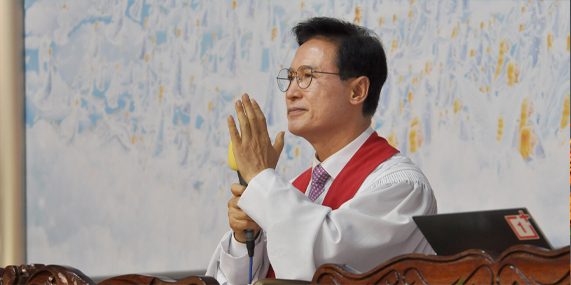
God Who Finally Makes Us Smile
Bible passage: Genesis 18:9-15
“9. "Where is your wife Sarah?" they asked him. "There, in the tent," he said. 10. Then the LORD said, "I will surely return to you about this time next year, and Sarah your wife will have a son." Now Sarah was listening at the entrance to the tent, which was behind him. 11. Abraham and Sarah were already old and well advanced in years, and Sarah was past the age of childbearing. 12. So Sarah laughed to herself as she thought, "After I am worn out and my master is old, will I now have this pleasure?" 13. Then the LORD said to Abraham, "Why did Sarah laugh and say, 'Will I really have a child, now that I am old?' 14. Is anything too hard for the LORD? ”
There is a saying that refers to the "aesthetics of waiting." It means that waiting for good people or good things is a happy experience.
However, no matter how good the outcome, if the waiting time becomes prolonged, frustration, anxiety, and disbelief will increase in proportion to the time spent waiting. In today’s scripture, Sarah was going through such difficulties related to waiting. In Genesis Chapter 12, when God called Abraham, He promised to give him a son. Abraham was 75 years old when he received the promise, and it was fulfilled when he was 100 years old.
For 25 long years after receiving the promise, there were times when Abraham and Sarah were overwhelmed with anticipation, and other times when they were in deep anguish. It is no exaggeration to say that their lives were a continuous process of waiting.
Today’s scripture tells the story in the 24th year after God promised to give them a son. Even though they had received the promise, waiting for 24 years without an answer would certainly make them exhausted and frustrated. From God’s perspective, He had planned to fulfill the promise a year later, so He knew they just needed to wait a little longer. But from Abraham and Sarah's perspective, they couldn’t know whether they would receive an answer even a day before it happened, which made them extremely weary and tired. In verse 10, God comes to Sarah, who is weary of waiting, and speaks concerning her, saying: "I will surely return to you at this time next year; and behold, Sarah your wife will have a son." In response, Sarah reacts as shown in verse 12 which says: "Sarah laughed to herself, saying, “After I have become old, shall I have pleasure, my lord being old also?”" God said that she would have a son a year later, but Sarah, too tired from waiting, laughed to herself.
The word "laughed" here in Hebrew is "tsachaq" . Depending on the context in which it is used, it can mean “laughing with joy” in a positive sense or “scoffing” in a negative sense. In verse 12, Sarah's laughter is not one of joy, but rather a scoff born out of displeasure. Imagine someone speaking quite seriously to you, but you don't take it well and respond with a dismissive "hmm" . How would you feel? How would you feel if you were earnestly talking to someone, but they responded with a dismissive "hmm"?
This is exactly what Sarah did in front of God’s promise - she scoffed at it. Sarah, who had been waiting for God's promise to be fulfilled for 24 years without a response, became too weary to trust in God’s promise, and she found herself disappointed and resigned. However, to conclude, in Genesis Chapter 21, we see that God fulfills His promise and Sarah receives a son, Isaac, bringing her joy. Genesis 21:5-6 says, "Now Abraham was one hundred years old when his son Isaac was born to him. Sarah said, “God has made laughter for me; everyone who hears will laugh with me.” " Here, Sarah’s laughter is filled with joy and genuine happiness. God does not let us have the bitter laughter of disappointment and defeat. Instead, He makes us laugh with the joy and emotion of victorious triumph. I hope you believe that.
Today, under the title "God Who Finally Makes Us Smile, " I would like to share grace with you by focusing on the scripture and discussing how God ultimately transformed Sarah's bitter laughter of disappointment into a joyful laugh of happiness. 1. God Who Finally Makes Us Smile is a ‘God Who Comes and Speaks to Us.’ In Genesis 18:1, it says, “Now the Lord appeared to him ………” God visited Abraham to reaffirm His promise that Abraham would have a son. Particularly in verse 9 of today's scripture, we see God personally seeking out Sarah, by asking, “Where is Sarah your wife?” This was to give Sarah, who had grown weary of waiting for the promise, reassurance that she would indeed have a son, and to comfort and encourage her. God’s promise to Abraham that he would have a son wasn’t the first time He made such a promise.
In Genesis 15:4, God said, “This man will not be your heir; but one who will come forth from your own body, he shall be your heir, ” promising him a son. And again in Genesis 17:19a, God said, “No, but Sarah your wife will bear you a son, and you shall call his name Isaac. ” Despite these promises, God visited Abraham and Sarah a third time, to strengthen their wavering faith by saying, in more detail, that they would have a son by the same time the following year. God did not leave Sarah, who was discouraged and whose self-esteem was low, abandoned in her state. Similarly, God reaches out to and meets with those who are disappointed and disheartened.
God visited Sarah to deliver the message found in verse 10, saying like, "You will have a son. This promise will surely be kept." He intended to comfort and encourage Sarah with these words. God is a God who personally comes to humans. Among the many religions in the world, only the God of Christianity is a God who comes to humans. For sinful humans, it is impossible to seek out God on their own. This is why the Son of God, Jesus, personally came to humans to save them - this is the event of the Incarnation. Therefore, Christianity is not about human effort but about receiving salvation through faith in this truth. Other religions claim that one can find God through human effort or self-discipline. However, it is impossible to meet God or attain salvation through such artificial means. God is the one who comes to us and speaks to us. When God came to Abraham and Sarah, Sarah laughed, or "tsachaq," because she was tired, discouraged, and found it hard to believe, so she scoffed.
This word "tsachaq" is also used negatively elsewhere. In Genesis 19:14, it says, “So Lot went out and spoke to his sons-in-law, who were pledged to marry his daughters. He said, “Hurry and get out of this place, because the Lord is about to destroy the city!” But his sons-in-law thought he was joking.” Here, "mocking" is "tsachaq." At this point, Lot, the father-in-law, is earnestly advising them to flee because the city of Sodom will be destroyed, but his sons-in-law take his words as a joke. Like Sarah, Lot’s sons-in-law did not take God’s words seriously, but dismissed them lightly and mockingly, treating them as a joke. God’s word could not penetrate their hearts, which were filled with sin, and was blocked by their fleshly thinking. When a road is blocked, traffic congestion occurs; when a blood vessel is blocked, it leads to a heart attack and threatens life; when the word is blocked in a person, there is no joy, happiness, blessing, or response. When a servant of the Lord stands at the pulpit and testifies to the Word, some people receive much grace, are moved, and respond fervently with "Amen."
These are people through whom the Word passes gracefully. I remember a young man who gave a testimony after an MIS education session in Uvira, Congo, last Thursday. He was greatly moved by the Word through this MIS education and testified that he would completely change his life and live a new one. By fully accepting the Word, his heart was pierced, and he became someone who smiles with true joy. However, some people’s reactions are entirely different - they are not moved. The Word does not enter; it bounces back. The Word is not accepted; they scoff at it like Sarah. However, if we look at the Bible, there is someone entirely different from this negative Sarah, who still found hope despite the slow fulfillment of God's promise. This person is Simeon from the New Testament.
Luke 2:25 says, “And there was a man in Jerusalem whose name was Simeon; and this man was righteous and devout, looking for the consolation of Israel; and the Holy Spirit was upon him.” Why was he waiting for the Messiah? The answer is in verse 26: It says, “And it had been revealed to him by the Holy Spirit that he would not see death before he had seen the Lord’s Christ.” The Holy Spirit had promised him, "You will see the Messiah in your lifetime." There is a commonality between Sarah and Simeon: both received a promise from God, both experienced a delayed response, and both grew old waiting for the promise. Both ended up with seemingly humble lives. However, there is a crucial difference between them; Simeon never once became disappointed while waiting for the promised word. Of course, Sarah also eventually received a response, and both ultimately received their promises, but the process leading up to the fulfillment was very different for the two of them. Aren't all of you people who wait for God's promises?
Then, there are two paths before us. One is the path Sarah walked. Due to the slow-coming response, one lives a life constantly feeling down, with low self-esteem, and lacking joy. And there is the path Simeon walked, where the delay in response becomes a source of hope. This is the fundamental difference between Sarah and Simeon. So, if any of you are exhausted from waiting like Sarah, if your heart has grown weary due to the prolonged delay of response, and you feel humble and the Word no longer penetrates your life, you must not leave yourself in that state. You must break through. Do not listen to the Word with scoffing. Do not dismiss the Word.
Today, when God comes to you and speaks His Word, I hope you do not scoff but receive it with an "Amen," and experience how that Word becomes the power that transforms your weary hearts and stagnant lives. 2. God Who Finally Makes Us Smile tells us not to be bound by our circumstances but to focus on His presence and advance in faith. Sarah ends up scoffing at God’s word, and the reason for her scoffing is recorded in verse 11. God promises Sarah in verse 10 that she will surely have a son, and in verse 12, Sarah scoffs. The content in verse 11, between these two verses, plays a crucial role in Sarah’s response of scoffing at God’s word.
God gives Sarah His promise in verse 10, but the reason she cannot receive it is detailed in verse 11. What does it say in between? Verse 11 says, “Now Abraham and Sarah were old, advanced in age; Sarah was past childbearing.” This verse records Sarah's realistic circumstances and conditions; She was old, had stopped having her period, and was too aged to bear a child. Therefore, in verse 12, even though God promised that she would have a son, Sarah scoffed. In this situation, where it was hard for her to say "Amen," God speaks directly. Verses 13-14 say, “And the LORD said to Abraham, “Why did Sarah laugh, saying, ‘Shall I indeed bear a child, when I am so old?’ Is anything too difficult for the LORD? At the appointed time I will return to you, at this time next year, and Sarah will have a son.”” Why did God, who knows all about these circumstances, appear directly to Abraham and Sarah? No matter how challenging your situation may be, "Sarah, do not look at yourself; look at Me, your mighty God."
God appeared in person before Abraham and Sarah, saying, "Look at Me." Faith is not about looking at and relying on oneself but looking at and relying on God. Why did Sarah fall into a state of discouragement? It was because she only focused on her desperate reality and circumstances. I came across an interesting article on neuroscience. It discussed how "raising the ceiling height increases creativity." It suggested raising the ceiling height at home to boost children's creativity. In Korea, there are many apartments, and the ceiling height of one floor in an apartment is 2.3 meters. 7 Scientists conducted experiments, and there is research showing that every 30 cm increase in ceiling height doubles creativity. Experts say that people's thoughts and behaviors are greatly influenced by the shape of the space they occupy. When the ceiling is low, people interpret the space as narrow, but when the ceiling is high, they interpret the space much more broadly, and it expands their thinking. The medical scientist who researched the relationship between ceiling height and creativity was Dr. Jonas Salk from the United States. After this research, when he built his laboratory, he raised the ceiling height by 70 cm to make it 3 meters.
This was not an ordinary person - he was the great medical scientist who first developed the polio vaccine, and his Salk Institute has produced five Nobel Prize winners to date. A research team led by Professor Minos Leddy at the University of Minnesota in the United States also researched and proved that ceiling height can affect cognitive abilities. Reflecting on this article, a passage from the Bible came to mind: Colossians 3:1- 2: It says, “Since, then, you have been raised with Christ, set your hearts on things above, where Christ is, seated at the right hand of God. Set your minds on things above, not on earthly things.” This article also reminded me of the window design in Noah's Ark. In Genesis Chapter 6, God instructs Noah to build an ark, and there is something peculiar about it. Genesis 6:16 says, “You shall make a window for the ark, and finish it to a cubit from the top; and set the door of the ark in the side of it; you shall make it with lower, second, and third decks.”
The ark's height was about 15 meters, and God instructed Noah to place the window one cubit below the roof. 8 One cubit is 45.5 cm, roughly 50 cm. So, while the ark was 15 meters tall, the window was to be placed just 50 cm below the roof. It might seem logical to place a large window on the side of the ark to have a good view outside, but why did God design it this way? If a large window were placed on the side of the ark, what would happen? When the window was opened, they would see the bloated, decaying corpses of drowned people and animals floating by, and the stench of decay would waft into the ark. It would be horrifying. Therefore, God made the window small and just below the roof so that when they opened it, they could only look up at the sky and breathe in fresh air instead of foul smells. What our young people need is to avoid living with a narrow perspective and narrow scope under a low ceiling but rather live with a broad vision and creativity. In the United States, people who are considered somewhat famous and successful, including Steve Jobs, often started their companies in a "garage." Most of them started in garages, which generally have high ceilings. Many of these people dropped out of college - some were even studying at prestigious universities like Harvard when they decided to quit and start their businesses. Their lives were not determined by such choices but rather by the belief that creativity is influenced by the height of the ceiling.
What does it mean to believe in Jesus? Even if we live in houses with low ceilings, our hearts can soar up to the high heavens where God lives, regardless of the ceiling height. Verse 14 should be applied in the same way to such people. 9 Regarding those trapped in verse 11, God says, "Who wouldn't know that you are of such age and that you have ceased menstruating and cannot have a child? Don’t you think I already know all about that situation? But why are you stuck in verse 11, unable to make progress in your faith? Is anything too hard for the Lord?" He says so in verse 14. Therefore, we must break out of verse 11 and make spiritual progress to verse 14.
If you are stuck looking at your situation in verses 12 and 13, your faith will remain stagnant, and you will miss out on the "opportunity to finally laugh." I hope you do not remain bound by your circumstances but focus on God's presence, advance in faith, and ultimately experience the victorious laughter of triumph.
3. To become a believer who can finally laugh, we must hold on to the living and active Word of God given to us. God promised Abraham that he would have a son not only this time but also in Genesis 15:4 and Genesis 17:19. In Genesis 17:18, when God said that He would give Abraham a son, Abraham responded like this: “Oh that Ishmael might live before You!” Even Abraham was not yet fully convinced about having a son and thought of Ishmael, born of Hagar, as his heir. To strengthen their faith, God visited Abraham and Sarah again and told them once more that they would have a son. Therefore, the statement "You will have a son" was not something Sarah heard for the first or second time; she had heard it several times already. When God came and spoke to her, Sarah listened, but there was nothing new in what God said. This time, as in previous times, the message was, "You will have a son."
Hearing once again a promise that had not been fulfilled up to that point, Sarah became disappointed and scoffed. 10 However, there is a crucial error in thinking that we must correct here. We need to understand that there are two types of words from God. While we often regard them all as just "words," in the Greek original, they are distinguished as "Logos" and "Rhema." If "Logos" refers to the general word given to everyone, "Rhema" is a specific, living, and active word given especially to us that can solve the problems in our life situations. Generally, everyone reads or hears the Bible, and that word is "Logos" .
However, there are instances where a specific word from the "Logos" strikes our hearts deeply, and that word becomes "Rhema" . Therefore, when we read the Bible or listen to the Word, we should not just treat it as a general word but seek the help of the Holy Spirit so that it may come to us as a personal word that can solve our problems and provide answers. God comes in verse 9, looking for Sarah, and engages in a conversation with her about "having a son" starting from verse 10. In verses 13 and 14, God helps transform the ordinary "Logos" word that Sarah had heard before into a special word, "Rhema" , that can actively work in her and solve her problem. Verses 13-14 say, “Then the LORD said to Abraham, “Why did Sarah laugh and say, ‘Will I really have a child, now that I am old?’ Is anything too hard for the LORD?
I will return to you at the appointed time next year, and Sarah will have a son.”” Therefore, when the response is delayed and we become weary and tired, rather than being disappointed, we must focus even more on reading and listening to the Word, asking for the Holy Spirit's help so that the "Logos" words can now come to us as "Rhema" words that work in our lives and solve our problems. Though it happened a long time ago, I had a spiritual experience like this. When I was young, I lost hope and wandered while suffering from a serious illness. One day, I was reading the Bible and came across Hebrews 13:8: 11 It says, “Jesus Christ is the same yesterday and today and forever.” Though I had read this verse many times before, that day, the verse struck me powerfully. I believed, "Jesus Christ is the same yesterday, today, and forever. Just as He came to this earth over 2,000 years ago, saving many people and healing diseases, He will also heal my sickness today." The verse, which had previously been a general "Logos" to me, became a special "Rhema" word that pierced my heart, and as a result, I was healed.
Before I was appointed to Nairobi Manmin Church, while preparing for the mission and praying at the headquarters in Seoul, Korea, I had a strong conviction about building a new sanctuary. It has already been a year since I arrived here. One day, while praying, the thought of building a new sanctuary strongly resonated within me. I felt a strong conviction that when I was appointed to Nairobi Manmin Church, I had to construct a new sanctuary. It was like moving from the era of Moses' tabernacle to the era of David's temple. The time when Israel was most blessed and prosperous both spiritually and physically was during the era of David's temple. Although the fact that David built the temple is a commonly read and heard "Logos" , it became "Rhema" for me and struck my heart.
Our church now needs to construct washrooms and build the sanctuary. Since the "Logos" word has come as a "Rhema" word, I believe that with God's help, we will accomplish it successfully. One should not follow others just because they do it. We must receive that word as "Rhema" ourselves and act upon it to receive a response. In Matthew Chapter 14, Peter walks on water. 12 Here, only Peter could walk on water, while the other disciples had to remain in the boat. If the other disciples had thought, "I should walk on water too," and jumped in, they all would have drowned.
Although they were all disciples of the Lord, why could Peter walk on water while the others couldn't? It was because Peter received the Lord's word "Come" as "Rhema" , while the others only heard it as "Logos" from the side. When faced with a crisis like Sarah and things become gloomy and dark, it would be good to recall Luke 5:4, which says, “Put out into deep water, and let down the nets for a catch.” Here, the Lord's word "Put out into deep water, and let down the nets for a catch" became "Rhema" for Peter, moving his heart. When he acted on that word, he caught a large number of fish. In the Greek original, "because you say so" is written as "Rhema" , not "Logos" .
When you have just opened a store and business is not going well, or when you get a job only to face the situation of having to leave soon after, it is time to rely on the Word. It is time to hold on to a Word not just as a simple "Logos" , but a "Rhema" inspired by the Holy Spirit that comes into your life and can solve your problems. Are there those who are disappointed because the response to the promise is too slow? If you have grown weary from the long wait and your heart is dark and your self- esteem shattered, this is precisely the time to hold on more closely to this promised Word. In conclusion: God ultimately made Sarah, who had grown weary from waiting, despairing, and disappointed to the point of not believing and scoffing at God's word, laugh with joy and gratitude.
“Sarah said, “God has made laughter for me; everyone who In the end, as God promised, Sarah bore a son and named him Isaac, which means "laughter." Genesis 21:6 says, hears will laugh with me.”” The word "tsachaq" is repeated twice here. In this context, "tsachaq" is not a scoffing laugh but a laugh of gratitude and happiness overflowing with the grace given by God. First, God makes me laugh, and then, the "tsachaq" laugh spreads to all those who hear my testimony. I believe that this will happen in your lives as well. When the people of Israel went from Egypt toward the land of Canaan, they faced countless trials and hardships in the wilderness but eventually entered the land of Canaan.
The Bible describes this situation as follows: Deuteronomy 8:16: “In the wilderness He fed you manna which your fathers did not know, that He might humble you and that He might test you, to do good for you in the end.” “To do you good in the end.” If you believe that the loving and almighty God of Manmin will ultimately make us all laugh with the laughter of gratitude, joy, happiness, and victory, say Amen. - END